Aso Ebi and Afterparty: The Planners Turning Weddings Into Full-On Cultural Productions
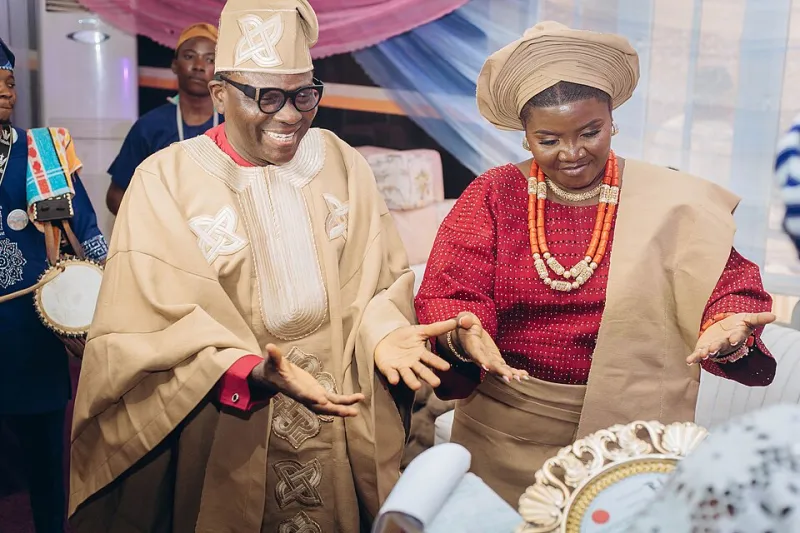
Photo: Bamjos, CC BY-SA 4.0, via Wikimedia Commons
A decade ago, a Nigerian wedding in Houston was a Saturday. Now it’s a long weekend — a traditional ceremony on Friday with its own outfits, the white wedding on Saturday, an afterparty that doesn’t end until somebody is being carried out of the hall, and often a Sunday brunch that functions as the official debrief.
That expansion is not an accident. It’s a business, and the people building it are wedding planners, fabric vendors, designers, caterers, and MCs who realized that the American wedding industry had essentially no idea what to do with them — so they built the playbook themselves.
Aso Ebi Is a Group Chat With a Dress Code
Start with the aso ebi, which is less a fashion choice than a logistical feat. One fabric. Dozens — sometimes hundreds — of guests. Everyone in a unified color story, everyone wearing a shape they chose for their own body, all coordinated through group chats that rival small enterprises in their complexity.
The planners who’ve figured this out have turned it into a service: fabric sourcing, tailoring directories, size collection, shipment tracking, and a WhatsApp thread that needs a dedicated manager. It’s emerging as a revenue line of its own, and it’s become one of the clearest examples of diaspora families paying for continuity rather than for decoration.
Kente, Gele, and the Family Negotiation
Then comes the blending, which is where things get interesting. A Ghanaian family might want kente for the traditional ceremony and a Western silhouette for the church. A Caribbean family might build in a jump-up element, a second-line moment, or a reception entry that turns the aisle into a parade. A Nigerian couple might want the gele tied with the specific height that reads as correct to aunties who will absolutely be inspecting it.
Managing all of that is 40 percent logistics and 60 percent diplomacy. Whose church? Whose pastor? Which grandmother gets the first dance? Where does the money dance fall, and how do you make sure it doesn’t feel like a jarring shift to guests who’ve never seen it before? The planners who last are the ones who treat the guest list like a small country with competing factions and a shared national interest.
Jump-Up Meets the Dollar Dance
What’s changing in 2026 is that these elements are no longer being tucked into a corner of the reception. They’re the centerpiece.
The crossover moment — where the older relatives’ music and the cousins’ music briefly intersect — used to be a five-minute window. Now DJs get hired specifically for their ability to stitch afrobeats, soca, highlife, dancehall, amapiano, hip-hop, and whatever the family’s church people will allow into one continuous arc. It’s its own craft. Get it right and you have 300 people on a dance floor who’ve never agreed on anything before.
The Business Behind the Belonging
Here’s the thing the mainstream industry keeps underestimating: this is a thriving market. Multi-day weddings with multiple wardrobe changes generate more demand per couple — for tailoring, backdrops, lighting design, food, photography, videography, transportation, and program printing. Planners who serve diaspora families in Atlanta, Dallas, the DMV, and the outer boroughs of New York have found they can build full-time businesses without chasing a single celebrity client.
But the real asset isn’t the calendar. It’s the network. A planner who has relationships with a reliable gele tier, a fabric importer, a vendor who can source jollof rice for 400 people, and a hall that will tolerate a live drum set at 11 p.m. is holding something that takes years to assemble. That’s the moat.
When the Culture Is the Client
That also raises the bar. Families are less interested in a wedding that looks “African” for the sake of an aesthetic and more interested in one that gets the details right — the order of the program, the protocol at the traditional ceremony, the way elders are seated and honored. Planners now field questions about which fabrics are appropriate, which rituals require which family members, and how to handle a mixed-religion or multi-country guest list without flattening anyone’s traditions into set dressing.
It’s not just a happy problem. It’s an editorial one, and it’s why the good planners describe themselves less as decorators and more as cultural producers. The work is closer to production design than to party planning.
The Last Dance
What’s left when the lights come up and the aso ebi goes to the dry cleaner? Usually a family group chat with 600 photos and a new benchmark for every wedding that follows.
The modern American wedding is being rewritten in real time by people who refuse to choose between the aisle and the afterparty, between the church and the court, between the old country and the new one. They’re just doing what diaspora families have always done: taking two sets of traditions and insisting on both.
And if the aunties are happy with the gele, that’s the review that matters.