Every Wall Tells a Story: How Black Global Citizens Are Turning Their Homes Into Living Archives
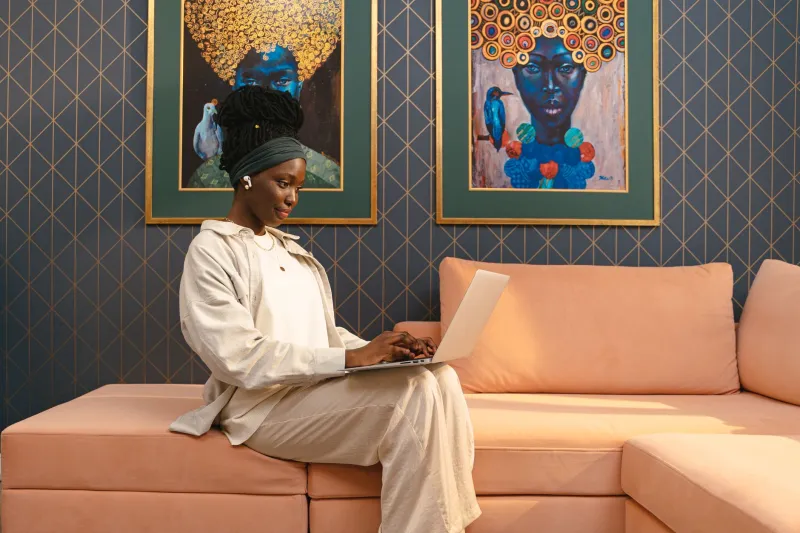
Walk into Adaeze Okonkwo's two-bedroom apartment in Crown Heights, Brooklyn, and the first thing you notice isn't the furniture. It's the feeling. A hand-carved Igbo stool sits next to a sleek West Elm side table. A framed Ankara print hangs beside a gallery wall of family portraits that stretch back three generations. A small clay pot her grandmother brought from Enugu rests on a floating shelf next to a Basquiat postcard and a Spotify-coded vinyl record from a Lagos Afrobeats artist she discovered last summer.
"People always ask me if it looks 'too much,'" Adaeze says, laughing. "I tell them: my grandmother's house was full. My mother's house was full. Fullness is how we show love."
For Black diaspora members across the United States, home design has quietly become one of the most personal and politically loaded creative acts of their generation. It's not about following trends on Pinterest or copying whatever algorithm-approved aesthetic is cycling through TikTok this week. It's about answering a deeper question: How do you make a place feel like home when home is a concept that spans continents, generations, and grief?
The Apartment as Archive
Interior designer Kemi Adeyemi, who splits her time between Atlanta and Lagos, calls it "memory architecture." Her design philosophy centers on the idea that a Black diaspora home should function the way a museum does—not a sterile, hands-off museum, but the kind where you're encouraged to touch things, to ask questions, to sit down and stay awhile.
"When I work with clients, I ask them to bring me objects before we talk about color palettes," Kemi explains. "Bring me what you carried. What your parents carried. What you bought at a market in Accra or found at a thrift store in Atlanta that reminded you of something you couldn't name. That's where we start."
This approach—anchoring design in personal and ancestral objects rather than trend-forward purchases—is showing up across diaspora communities in cities like Houston, Chicago, D.C., and Miami. And it's not just West African diaspora communities doing it. Caribbean-American, Afro-Latinx, and East African households are all navigating the same creative tension: how do you honor where you came from while fully inhabiting where you are?
For Haitian-American artist and set designer Marlène Pierre, the answer lives in color. Her New Orleans apartment is a riot of indigo, gold, and deep red—colors she says are pulled directly from the Vodou ceremonial cloths her aunt kept in a trunk in Port-au-Prince. "Those colors are spiritual technology," she says. "When I surround myself with them, I feel protected. I feel located. I know who I am."
Design as Resistance
There's something quietly radical about the way diaspora creators are approaching their spaces, especially in the American context. For decades, Black Americans were either priced out of the neighborhoods they wanted to live in or pressured—through real estate discrimination, social assimilation, and aspirational marketing—to design their homes in ways that looked "neutral," which usually meant white.
The current generation isn't having it.
"Minimalism was never ours to begin with," says Marcus Webb, a Houston-based interior stylist whose Instagram account documenting diaspora homes has grown to over 200,000 followers. "African design traditions are layered, textured, loud in the best way. When we strip that out to fit into a HGTV aesthetic, we lose something real."
Marcus's feed is a corrective—a scrollable archive of living rooms draped in kente, kitchens hung with calabash art, entryways where Yoruba proverbs are stenciled directly onto the wall. His comment sections read like a collective exhale. Finally. This is what my mama's house looked like. This is what I've been trying to do for years.
What Marcus and designers like him are naming is a form of cultural resistance that operates through the everyday. You don't have to march or post a thread to push back against erasure. Sometimes you just hang your grandmother's headwrap on the wall and call it art—because it is.
The Spiritual Dimension
For many diaspora households, the home isn't just a living space. It's a sacred one. Altars, ancestral shrines, and spiritual corners are increasingly visible features of diaspora interiors—not hidden away or apologized for, but integrated into the design with intention and pride.
Nairobi-born, D.C.-based photographer Amara Njoki keeps a small ancestor altar near her front door—a practice she adapted from her grandmother's Kikuyu traditions. It holds a photograph of her late father, a handful of soil she brought back from her family's land in Kenya, and a small glass of water that she refreshes every week. "It grounds the whole apartment," she says. "Every time I walk in or out, I'm reminded of where I come from. That's not decoration. That's orientation."
This integration of spiritual practice into design is something interior designers working in diaspora communities are increasingly asked to accommodate and honor. Kemi says she now always asks clients early in the process whether they have ancestral or spiritual practices that should shape the space. "It used to feel like a sensitive question," she admits. "Now people are relieved someone asked."
Intergenerational Dialogue, One Object at a Time
Perhaps the most moving dimension of this design movement is what it communicates across generations. When diaspora parents intentionally incorporate cultural objects into their American homes, they're doing something that no curriculum or conversation fully replicates: they're making identity visible and tactile for their children.
Adaeze's eight-year-old daughter, Chisom, knows the story of every object in their Crown Heights apartment. She knows the stool came from her great-grandfather's compound. She knows the Ankara print was chosen because the pattern is specific to their region of Igboland. She knows the clay pot holds nothing now—but once held water for a woman she never met, who loved a land she's never seen.
"She'll carry those stories," Adaeze says. "And one day she'll put those objects in her own home, and she'll add hers to them. That's how we survive."
Making It Your Own
For diaspora members who want to start building these kinds of intentional spaces but don't know where to begin, the designers we spoke to offer the same starting point: don't shop first. Remember first.
Pull out the objects you already have—the ones that came with you, or were passed down, or that you bought somewhere that felt like recognition. Ask your parents what they kept and why. Look at old family photos and notice what's in the background. Then build outward from there.
The goal isn't a showroom. It's an agora—a living, breathing gathering place where culture isn't just displayed, but practiced. Where every object is a conversation starter, every wall holds a memory, and every room says, without apology: we were here, we are here, and we're not going anywhere.
That's not just interior design. That's an inheritance.